The Art of Rent Globalization Monopoly and the Commodification of Culture
Commodification, Diffusion, and Defusion

Background
Groundwork:
In today's globalized globe, a world at serious risk of plummet nether capital'south influence, savvy companies generate unimaginable profits through the distilling, bottling, and selling of subcultures and movements. In the words of David Harvey in his 2002 commodity 'The Art of Hire: Globalization, Monopoly and the Commodification of Civilisation', "That culture has become a commodity of some sort is undeniable" (Harvey: 94). Despite many subcultures' and subculturists' oppositional stances toward capitalism, consumerism, and mainstream culture more than generally, they are frequently the target of commodification, diffusion, and defusion. This process has go effectively unavoidable for any subcultural group in modern day gild, so an understanding of how commodification occurs is essential to sympathise how subcultures exist in today's earth.
Commodification
Commodification is a process that almost all subcultures seem to encounter at some point in their life cycle. One time a particular subculture reaches a certain level of popularity in its membership, or at least one time the general public's sensation of it reaches a certain level, companies

Commodification can plough anything into a source of turn a profit
begin marketing the identifying visuals or popular behaviors of that subculture for profit outside of the subculture itself. Items and ideas that in one case were once primarily used by members of a subculture get marketed to others, sometimes initially by members of that subculture, but e'er eventually past larger organizations for the economic benefit of the surrounding gild. Information technology is often these adequately capitalist ethics of individual gain, profit, and prioritization of economic growth that subcultures try to resist, even so with the deviant behaviors of subcultures frequently being alternative forms of consumption, commodification can be nigh on impossible to avoid (Haenfler 2014: 93-iv). A subculture'southward alternative behaviors are often based around buying and attending different things, due to the alternative ideas and beliefs these subcultures have, so any subculture gaining popularity and public sensation will eventually reach a point where their ideas and behaviors get easier to market for profit.
Commodification of a subculture's items and practices oftentimes occurs co-ordinate to a sure cycle through which these features lose their initial meaning and significance. These behaviors and items frequently begin within a subculture as symbolic forms of resistance, attempting to subvert the societal norms these groups deviate from. Eventually, yet, those exterior the subculture take an interest in these behaviors, making them more easily marketable, and diffusing these ideas throughout mainstream guild. After this, the behaviors and items are defused from what they originally represented, coming to represent something more mild and non-deviant for mainstream gild. At this betoken, what were once important signifiers of a deviant subculture go a commodity as they lose all their original significance for an extended time, until mainstream civilization changes such that they can gain new significance or be subversive once again. Each of these steps is significant in understanding the procedure by which commodification has continued to occur in our society.
Two Forms of Incorporation
In his foundational text, 'Subculture: The Meaning of Style' famed subcultures scholar Dick Hebdige points out that the growth of subcultures "invariably ends with the simultaneous improvidence and defusion of the subcultural style" (93). While we find this idea not entirely true, finding that movements and subcultures tin, in fact, cease their movement and aspects of information technology from being undermined by Diffusion and Defusion, Hebdige'southward ideas of the two are central to both of the following sections.
Diffusion
Diffusion involves the spreading of subcultural ideas, values, fashions and creations into more than mainstream society. Diffusion works as a part of the commodification process as capitalists target items or concepts for commodification and and so spread them through the promotion and sale of goods. Diffusion sometimes initially happens organically as non-members of a subculture take an interest in the items or concepts that are role of it, which then leads to the commodification of these things. Subcultural non-members that purchase subcultural goods tin movement quickly and freely from one fashion to some other without because their significance because they accept no ideological commitment to whatever particular subculture (Arthur 2004). If follows that the diffusion and commodification of subcultural goods, ideas and practices can threaten the integrity of these differentiating symbols and lead to defusion (Arthur 2004; Haenfler 2014: 97).

Diffusion disperses something into the surrounding mainstream
In Subcultures: The Basics, author Ross Haenfler describes diffusion. First, cultural diffusion is described as "the spread of all sorts of cultural artifacts between individuals and groups" (Haenfler 2014: 128). Centralized diffusion entails governments or large corporations purposefully and sometimes aggressively promoting objects or ideas (Haenfler 2014: 128). In dissimilarity, decentralized improvidence is characterized as less organized and managed. Subcultural improvidence is both centralized and decentralized (Haenfler 2014: 128-9). Consumerism and the market are a large part of what fuels this diffusion, with consumers crossing boundaries in order to pursue and further their "identity projects," appropriating items or symbols they like in order to portray themselves in a way that is consistent with how they view themselves and/or wish to be perceived (Fernandez & Figueiredo 2018: 297).
Claude Fischer, in "Toward a Subcultural Theory of Urbanism," discusses diffusion betwixt subcultures, as opposed to between a subculture and mainstream society. Fischer asserts that the rate and management of improvidence depends on the size, intensity, level of similarity, extent of contact, relative power and prestige and "the utility of the borrowed item" (Fischer 1975: 1327). While this diffusion does take the potential to harm the integrity and resistance potential (see defusion) of a subculture, it can also lead to "social innovation" through the mixture and recombination of (sub)cultural elements (Fischer 1975: 1328).
Defusion
Not to be dislocated with diffusion, defusion describes the depoliticization of something and its transformation into a new and less 'radical' version of what it was. It is frequently a issue of commodification and diffusion and is a symptom of the process of companies and 'social-capitalists' (individuals who proceeds popularity by strategically deploying things and ideas) using the, frequently altered, prototype of the original thing for their own economical or personal do good.

Defusion disconnects something from its original purpouse
The process of defusion can be thought of as cutting the fuse off of something or, in other words, removing/destroying/sabotaging information technology'due south potential to be subversive or change anything and, although it may still look like information technology did prior to the process, leaving it inert.
If commodification can be thought of as the bottling and selling of something and diffusion the widespread dissemination or spreading of it, defusion tin can be thought of equally the touch on the previous two have on the thing that experienced this process. When applied to subculture studies, nosotros see defusion take shape after commodification and improvidence have made participation in the subculture a purchasable article and substantially broadened the reach or visibility of it. When we look closely, we can see defusion in the examples provided for both commodification and improvidence, to encounter it more clearly nosotros will further explore these aforementioned groups and how defusion has impacted them, and so look at how a group of anti-gentrification activists are currently fighting their move's defusion.
Subcultural Examples
Examples:
Commodification
This process of commodification occurs most often in regard to things that identify a subculture visually, such as wear and symbols, but as well takes advantage of the ideologies surrounding all the alternative behaviors of a subculture. How features of a subculture become

Leather biker jacket being modeled
commodified is illustrated well by the subculture of bikers and motorcycle groups, who have been heavily influenced past corporate interests as they've developed. This occurs well-nigh obviously from the selling of the motorcycles themselves, as owning a motorcycle is essential to participate in these groups that spend much of their time traveling across parts of the country together. As these groups get more pop, withal, while money tin can apparently exist made from the marketing of motorcycles, other items such as leather jackets, helmets, and the symbols of dissimilar biker groups tin can likewise be quite assisting. Within the subculture, these other items serve a primarily practical value for members to identify fellow members as well as for safety reasons when riding a motorcycle; they take a unlike value for the general public, however, who enjoy the novelty and statement that owning subcultural items tin have. This is why commodification is constructive and profitable, subcultural items that are oftentimes initially deviant can develop a certain "absurd" as a subculture grows, particularly when they brainstorm to be marketed to those outside of the original group (Haenfler 2014: 94-5). To help sell products linked with the motorcycle subculture, companies strategically hijack the associated ideologies for marketing purposes, emphasizing the freedom of the open road while minimizing the violent and criminal associations of "outlaw" biker groups (Haenfler 2014: 95-six).
Improvidence
In "culling to what? subcultural capital and the commercialization of a music scene," author Ryan Moore provides an example of subcultural diffusion. Moore studied the alternative rock subculture in the 1990s and the mode that advertisers used the subcultural symbols, images and ideas of a group that in some ways divers themselves by their "commercial independence and autonomy from mainstream civilisation" in guild to market their products and services to a younger demographic ( Moore 2005: 236). After the success of bands like Nirvana and Pearl Jam, the alternative rock or "grunge" subculture became available to a mass market. Both the punk and heavy metal subcultures influenced the grunge or alternative rock style, which seemed a highly unlikely candidate for adoption into the commercial culture ( Moore 2005: 238). In fact, 1 of Nirvana'southward most pop and commercially successful songs was " Smells Like Teen Spirit ," which Moore describes as "an indictment of the ways young people had been sedated by media and consumerism" ( Moore 2005: 238). Despite the anti-commercial nature of the subculture, the culture industry converted the sense of "actuality, rebellion, and coolness" into an bonny commodity ( Moore 2005: 232).

Alternative Rock Concert
The fashion and innovations of the alternative rock/grunge subculture spread chop-chop, "suddenly, … 'grunge' seemed to take captured the angst of millions of young malcontents" ( Moore 2005: 238). The mode section of the New York Times even weighed in with stories similar " Grunge: A Success Story " ( Moore 2005: 239). The wait that distinguished members of a subculture that considered themselves "the enemy of capitalism and mainstream society" was now available in stores across the country ( Moore 2005: 241). Even today, a quick Pinterest or eBay search of "grunge" volition consequence in countless outfits or items available for purchase.
Corporations were eager to align themselves with music, way, and celebrities that were perceived as authentic and cool. "Ironically, 'alternative was used as a buzzword to effort to convince young people" that they were buying something somehow inherently different than the other packaged goods on the market ( Moore 2005: 239). When subcultures experience diffusion, all the same, reaching a larger audition and widening their presence in mainstream social club, they can lose the sense of actuality that likely contributed to their initial entreatment. They then terminate to be perceived every bit cool or rebellious, thus also limiting their pregnant to both those within and those exterior the subculture as well equally decreasing their profitability in the optics of marketers. Moore describes the paradoxical effect that public reactions to subcultures and deviance tin can have; while authorities oft amplify deviance in the process of trying to eradicate it, corporations oftentimes squash the very rebellious qualities from which they are trying to profit ( Moore 2005: 235).
Defusion
When we look closely, we can see defusion in the examples provided for both commodification and diffusion, to see it more conspicuously we will offset revisit the aforementioned examples and how defusion has impacted them and then we volition look to how a group of anti-gentrification activists are currently fighting their motility's defusion.
U.S. Motorcycle Riders:
In the case of the commodification of motorcycles and the subculture of those who ride them, defusion can be seen as the 'taming' of the boilerplate motorcycle rider which has occured every bit more and more than people begin to participate and, in doing so, further defuse the original subculture and its radical potentials (both for what you might retrieve of as both 'good' and 'bad' deviance). Motorcycle riders who were in gangs are, disallowment some sort of change of heart, however of course deviant and unsafe to others, however, the act of riding a motorcycle is now seen by the general population as being largely neither of those things. This is reminiscent of how Dylan Clark describes commodification, diffusion, and defusion of the punk subculture/movement in his article ' The Decease and Life of Punk, the Final Subculture ' in that, though many more people are now 'punks', with that diffusion, the radical nature and significance of punk as a subculture (that was[is] a threat to the dominant civilization which relied[relies] on a passive response to hierarchy and oppression) is macerated, nonetheless, in spite of the change in the subculture as a whole, a small cohort who embody the original ethos even so remains amongst the larger group (Clark 2003).
U.S. Culling Rock:
For the example of 'alternative rock' in the 1990s, one can see that as the music became increasingly popular, along with the music itself, its elements, aesthetics, and themes began to appeal to mainstream audiences and, consequently, announced in advertising more than and more. These shifts evidence both improvidence and commodification but they as well show defusion in that the 'edgy' and 'culling' aspects of the genre began to be subsumed into the dominant culture that information technology sprang up as an alternative to.
U.S. Anti-Gentrification Activists:
Though, as yous can imagine and have merely seen, in that location are countless examples of defusion 'succeeding', it would be an error to think of it every bit an unstoppable forcefulness. Recently Los Angeles, California anti-gentrification group Defend Boyle Heights worked to kick a Telly evidence they felt fabricated light of and exploited their struggle out of their community. The testify Starz 'Vida' which is set in east Los Angeles, is almost the life of two sisters, the circumstance of their lives, and the fight confronting gentrification in eastward L.A. and in a statement on their website they say the testify:
…tastelessly exploits the anti-gentrification struggles of Boyle Heights. It pokes fun at the serious motility organizing around tenants rights, deportation defense, and police brutality…The process of stealing [activist groups] image for profit is a articulate instance of using an autonomous grouping's feel to go famous while these producers & artists have Null responsibility for supporting tenants rights struggles or helping people fight Ice deportations. How are these folks different from Disney trying to copyright Dia de los Muertos? Shame on these T.V. actors, actresses, and producers for sucking the life out of our customs just so hipsters can watch the testify and go along to romanticize Boyle Heights as some exotic ethnic enclave.
This statement shows they recognize the prove'southward portrayal of life in their community and their motility confronting gentrification'southward drivers is a part of the procedure of commodification, diffusion, and, eventually, defusion which stands to undermine their mission and destroy their community. The statement as a whole, and peculiarly the finish, show that the group recognizes that their way of life and community are being made into a commodity. This is in line with Harvey'southward idea that "The perpetual search for monopoly rents entails seeking out criteria of specialty, uniqueness, originality, and actuality…" ( Harvey 2002: 100). In other words, in their search for the newest, 'hottest', and 'realest' thing to attract viewers and gain relevance, participants of the civilization industry (TV executives in this case) have used (or tried to) Boyle Heights' mode of life and anti-gentrification movement as a symbol or prop (commodity) that can be used to sell their show to viewers. Put simply, the show is stealing the authenticity of the customs and their movement to legitimize itself. Beyond that recognition, Defend Boyle Heights so worked to nip the process in the bud. As a means of doing this, they worked with other local groups to stage a boycott and went on social media platforms like Facebook and Instagram to raise sensation among their allies and the public well-nigh bug with the prove and its potential impacts. All in all, as their movement gains steam and racks upward a cord of victories , Defend Boyle Heights is seeking to prevent the commodification, diffusion, and defusion of their struggle and, with their serious stance and actions, they seem to be holding their ground.
This video shows the group with other allied groups protesting an art opening. A few members of Defend Boyle Heights went from Los Angeles to New York Urban center and worked with a number of like groups in New York to protest a big opening by a high-level gentrifying artist.
Media
Media
The music video for the popular aforementioned Nirvana song "Smells Similar Teen Spirit."
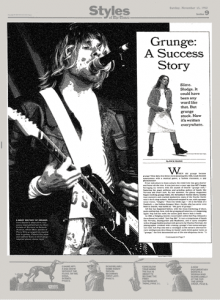
Comprehend folio of "Grunge: A Success Story"
https://www.nytimes.com/1992/11/15/style/grunge-a-success-story.html
This article is mentioned in the text, "Grunge: A Success Story" past Rick Marin, and was published by the New York Times in 1992. The article discusses how grunge transitioned "from subculture to mass culture."

Grouping photo of the ring Soundgarden
https://noisey.vice.com/en_uk/article/4xwbz3/defining-and-defying-the-times-how-soundgarden-made-badmotorfinger
This article, titled "Defining and Defying the Times: How Soundgarden Fabricated 'Badmotorfinger'" is about an alternative stone ring and touches on the making of culling rock equally well as other bands that influenced Soundgarden including Nirvana. In the interview, they affect briefly on ideas of improvidence.
This statement (click outset two words for link!) from Defend Boyle Heights titled 'Solidarity Or Shame; The Revolution Will Non be Columbused past Tanya Saracho' shows the grouping's objections to the TV show 'Vida' and their filming in East Fifty.A.. It also shows the group clearly recognizes the office this show could have in commodifying, diffusing, and defusing their movement.
This video depicts a typical anti-gentrification protestation from the group Defend Boyle Heights. They make signs then protest in an uncivil and effective manner.
Sources
WORKS CITED
Arthur, Damien. 2004. "The Diffusion of Style: A Qualitative Investigation of Australian Hip Hop Culture." The University of Adelaide.
In this article, Damien Arthur describes the process of subcultural improvidence. Focusing on the case of Australian Hip Hop, Arthur introduces ideas applicable to the diffusion of many subcultures.
Clark, Dylan. 2003. "The Death and Life of Punk, The Last Subculture," pp. 223-36,
In David Muggleton and Rupert Weinzierl (eds.), The Post-Subcultures Reader. Oxford: Berg.
In this work, Clark describes how contrary to the idiom 'Punk is Dead', punk has really shed its skin and lives on in the actions of those who embody its ethos. The piece of work explores themes of commodification, diffusion, and defusion, simply more importantly how a subculture or motility tin avoid the trio's negative impacts.
Fernandez, Karen V. and Bernardo Figueiredo. 2018. "Bridging boundaries in consumption, markets, and culture." Consumption Markets & Civilization (21)4: 295-300.
In this article, Karen V. Fernandez and Bernardo Figueiredo clarify the boundaries present in markets. The "bridging" of boundaries by consumers is continued to our themes of commodification, diffusion and defusion.
Fischer, Claude S. 1975. "Toward a Subcultural Theory of Urbanism." The American Periodical of Folklore (80)six: 1319-1341.
In "Toward a Subcultural Theory of Urbanism," Fischer uses subcultures as a lens for examining cities. In doing so, Fischer touches on the process of diffusion.
Haenfler, Ross. 2014. Subcultures: The Nuts. London and New York: Routledge.
Our text for this course provides a background on the study of subcultures and information almost each of our three specific topics. This served as the footing for much of our conceptualization.
Harvey, David. 2002. "The Art of Rent: Globalization, Monopoly and Commodification of Culture." Socialist Register (38): 94-110.
In this article, David Harvey describes the commodification of civilisation, introducing the concept of monopoly rent. Harvey helps situate the style that civilization is construed and used in a capitalist lodge.
Hebdige, Dick. Subculture: The Meaning of Style . Methuen, 1979.
In this foundational text, Hebdage explores Brittain's post-war youth subcultures and makes a case for their style as a grade of resistance. His idea of incorporation and its parts diffusion and defusion were crucial for this work.
Moore, Ryan. 2005. "alternative to what? subcultural majuscule and the commercialization of a music scene." Deviant Behavior (26)three: 229-252.
In this article, Ryan Moore writes almost the commercialization of subcultures. By focusing on the culling stone or "grunge" subculture, Moore provides a powerful example of the ways in which the culture industry tin have subcultures that are, at their core, anti-capitalist and commercialism, and use them to make a profit.
Source: https://haenfler.sites.grinnell.edu/commodification-diffusion-and-defusion/
Belum ada Komentar untuk "The Art of Rent Globalization Monopoly and the Commodification of Culture"
Posting Komentar